Which is better: MRI vs CT scan for brain? Understanding the key differences
When it comes to diagnosing brain conditions, one common question patients ask is: “Which is better: MRI vs CT scan for brain?”
Both imaging tests play a vital role in detecting abnormalities, but they differ in how they work, what they show, and when each is preferred.
Understanding the key differences in the MRI vs CT scan for brain can help you make informed decisions about your health and discuss the best option with your doctor.
What is a CT scan?
A CT (Computed Tomography) scan is a medical imaging test that uses X-rays to create detailed cross-sectional images of the inside of your body.
During the procedure, you lie on a motorized table that moves through a circular scanner, which rotates around you to capture X-ray images from multiple angles. These are processed by a computer to produce detailed 2D or 3D images of internal structures.
CT scans are highly useful in emergency and diagnostic settings, helping quickly detect bone fractures, tumors, internal bleeding, blood clots, joint issues, and cancer development. Their speed and precision make them invaluable for fast and accurate medical evaluations.
What is an MRI scan?
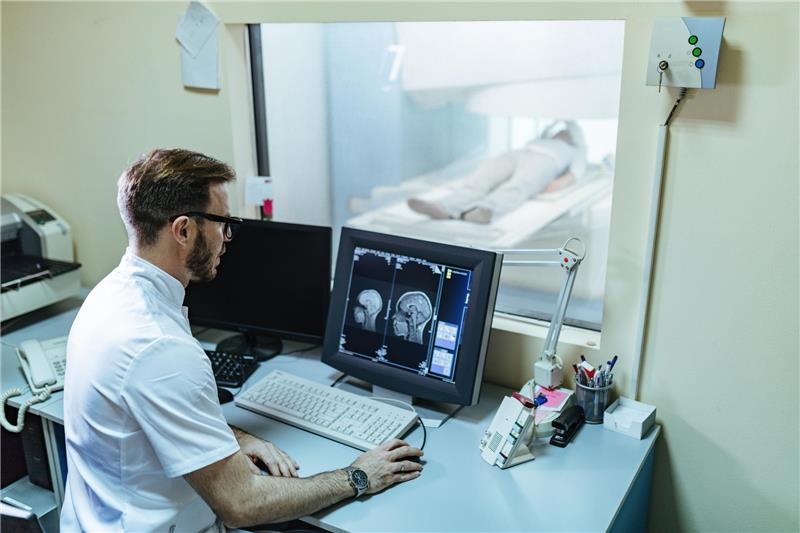
An MRI (Magnetic Resonance Imaging) scan is a non-invasive diagnostic technique that uses powerful magnets and radio waves to produce highly detailed images of the body’s organs and tissues.
During the procedure, the patient lies still inside a large cylindrical scanner. Unlike CT scans, MRIs do not use ionizing radiation, making them a safer choice for individuals who need repeated imaging or for pregnant women.
MRI scans are especially effective in detecting neurological disorders, soft tissue injuries, and abnormalities in the brain, spinal cord, and joints.
MRI v CT scan for brain: Key differences
Both MRI and CT scans are valuable tools for diagnosing brain conditions, but they differ in technology, detail, and purpose. Here’s a breakdown of the key differences between MRI and CT scans:
Features | MRI scan | CT scan |
Technology used | Uses strong magnets and radio waves to create detailed images | Uses X-rays and computer processing to form cross-sectional images |
Radiation exposure | No ionizing radiation – safer for repeated use and pregnancy | Involves low doses of ionizing radiation |
Image | Provides highly detailed images of soft tissues, brain structures, and nerves | Better for viewing bones, bleeding, and fractures |
Best for | Detecting brain tumors, multiple sclerosis, stroke, infections, and nerve injuries | Identifying skull fractures, brain bleeding, trauma, or swelling |
Scan time | 15-60 minutes | Much faster – usually 5–10 minutes |
Comfort and noise | Requires lying still inside a closed scanner; can be noisy but earplugs are provided | More open and quiet; generally more comfortable and quicker |
Cost | Generally more expensive | More affordable and faster to perform |
Which is better: MRI vs CT scan for brain?
The choice between an MRI vs CT scan for brain imaging depends on the specific medical concern and the urgency of the situation.
MRI is generally better for detailed brain imaging, especially when evaluating soft tissue, nerves, and neurological conditions such as:
- Brain tumors
- Multiple sclerosis (MS)
- Infections or inflammation
- Stroke (after the first few hours)
- Structural or developmental abnormalities
CT scans, on the other hand, are quicker and more effective in emergencies, making them the preferred choice for:
- Head injuries or skull fractures
- Acute bleeding, such as in a hemorrhagic stroke
- Brain swelling or trauma-related damage
When do doctors recommend each test?
Doctors choose between an MRI or a CT scan for the brain based on your symptoms, medical history, and the type of information they need. Here’s when each is typically recommended:
MRI scan | CT scan |
MRI is preferred when detailed soft tissue imaging is required or when doctors suspect conditions that involve the brain, nerves, or spinal cord. It’s commonly recommended for:
| CT scans are often chosen for urgent or emergency situations where quick results are essential. They’re ideal for detecting:
|
Need reliable imaging? Trust DMDC!
When it comes to understanding your brain health, choosing the right scan – whether MRI or CT – can make all the difference. Both tests offer valuable insights, but the best choice depends on your symptoms, medical history, and your doctor’s recommendation.
With over 500,000+ patients served and 25 years of trusted excellence, DMDC stands as one of Dubai’s most reliable diagnostic centers. Whether it’s an MRI or a CT scan, our commitment is to provide accurate results, advanced technology, and exceptional patient care every step of the way.
Our expert radiologists and cutting-edge imaging systems ensure precise diagnosis and a comfortable experience for every patient – because your health deserves nothing less than the best.
FAQ's
CT scan or MRI – which is better for brain imaging?
It depends on your condition. An MRI provides more detailed images of the brain’s soft tissues and is ideal for detecting tumors, multiple sclerosis, and nerve-related issues. A CT scan is faster and better for identifying bleeding, fractures, or trauma, especially in emergencies.
Is an MRI safer than a CT scan for the brain?
Yes. MRI scans don’t use ionizing radiation, making them safer for patients who need repeated imaging or are pregnant. However, CT scans are perfectly safe when medically necessary and use very low radiation doses.
Can a CT scan detect brain tumors?
Yes, CT scans can detect large tumors or masses. However, an MRI offers greater detail and is typically the preferred method for diagnosing and monitoring brain tumors.
Can I have both MRI vs CT scan for brain?
Yes. In some cases, doctors may recommend both to get complementary information – a CT for bone or bleeding, and an MRI for soft tissue or nerve detail.